The opening
This brief is about a customer storytelling program I led at Fivetran in 2022, while the company was moving upmarket. Fivetran took on the work data engineers spent most of their week on. Getting data leaders to imagine the strategic work they could do instead was the marketing job. The program produced 20 customer stories, five of them anchored by hero videos. The thinking behind it is what I'd bring to OpenAI.
To build it, we started with the sales team. Talking to them about how deals were closing at our enterprise accounts, we noticed the deal almost always came down to one person inside the customer: a data engineer, a head of data, or an architect who'd evaluated Fivetran, advocated for it internally, and had gone to bat for it in front of their team. That person was the champion, and the deal moved at their speed.
So we made the champion the hero of every story.
Marketing a product that disappears
Fivetran's brand was reliability. It just works. You set it up, walked away, and the data flowed. The whole point was that you wouldn't think about Fivetran again, and most customers didn't. The product was engineered to disappear.
Fivetran took on the work data engineers used to spend most of their week on: building and maintaining pipelines, watching for schema drift, fixing what broke at 2am. With Fivetran handling that, our customers could finally get to the strategic projects they'd been promising themselves for years.
The more time Fivetran gave back to data leaders, the less they thought about Fivetran itself. Some marketers would treat that as a weakness; we treated it as the point. The conventional move would have been to fight the invisibility with benchmarks, uptime claims, and connector counts. We did the opposite. We put the product behind the customer and let it stay there.
The bet was that a data leader watching one of our customer heroes would recognize a job that looked a lot like their own, except a version that was working better. A preview, not a fantasy.
Picking our heroes
We picked five customers. Each one was a different argument.
- JetBlue was the program's lead. A 25-year-old aviation enterprise, the kind of name a CIO recognizes, with a head of data engineering named Ashley Van Name who'd built exactly the kind of team and operation we wanted other data leaders to see themselves in. JetBlue said Fivetran was enterprise-ready so we didn't have to.
- ExxonMobil was the legacy-enterprise complement. A Fortune 500 oil and gas company where data infrastructure had been accumulating for fifty years. If Fivetran could work there, it could work anywhere.
- The Denver Broncos broke the data-engineering archetype. NFL franchise, sports vertical, a name recognized well outside the buyer category.
- Blend was the prototypical Fivetran customer. Late-stage scale-up, post-IPO, fintech. Where most of our ARR came from.
- Untitled Agency was a different kind of customer entirely. Powered by Fivetran is the embedded version of the product: software companies build it into their own platforms so their customers get integrated data without ever knowing Fivetran is underneath. Untitled was the hero for that motion.
Inside JetBlue
Ashley runs data engineering at JetBlue. Her team consolidates hundreds of sources into a single working picture of the airline, with Fivetran handling the pipelines.
"An airline is like an orchestra. You only know something's wrong when it's out of tune," Ashley said. She was describing JetBlue's operational complexity, but she was also describing Fivetran: when the pipelines work, nobody notices; when they break, every downstream system breaks with them. The data team's job, she said, was to keep the orchestra in tune.
Ashley was telling the audience how to think about her job. We let her.
The system behind the hero
The format had three rules: keep the product out of the hero video, give every customer a technical companion, and let the surrounding artifacts carry the product details. We applied the rules across all the stories.
The hero cut was the customer in their own words, no product on screen. This was the version of the story we showed everyone, the same approach we'd used with JetBlue, applied to ExxonMobil, the Broncos, Blend, and Untitled.
The technical cut was its opposite: full of product walkthroughs, screenshots, and behind-the-scenes detail. That version stayed inside sales conversations, where engineering buyers needed to see exactly how it worked.
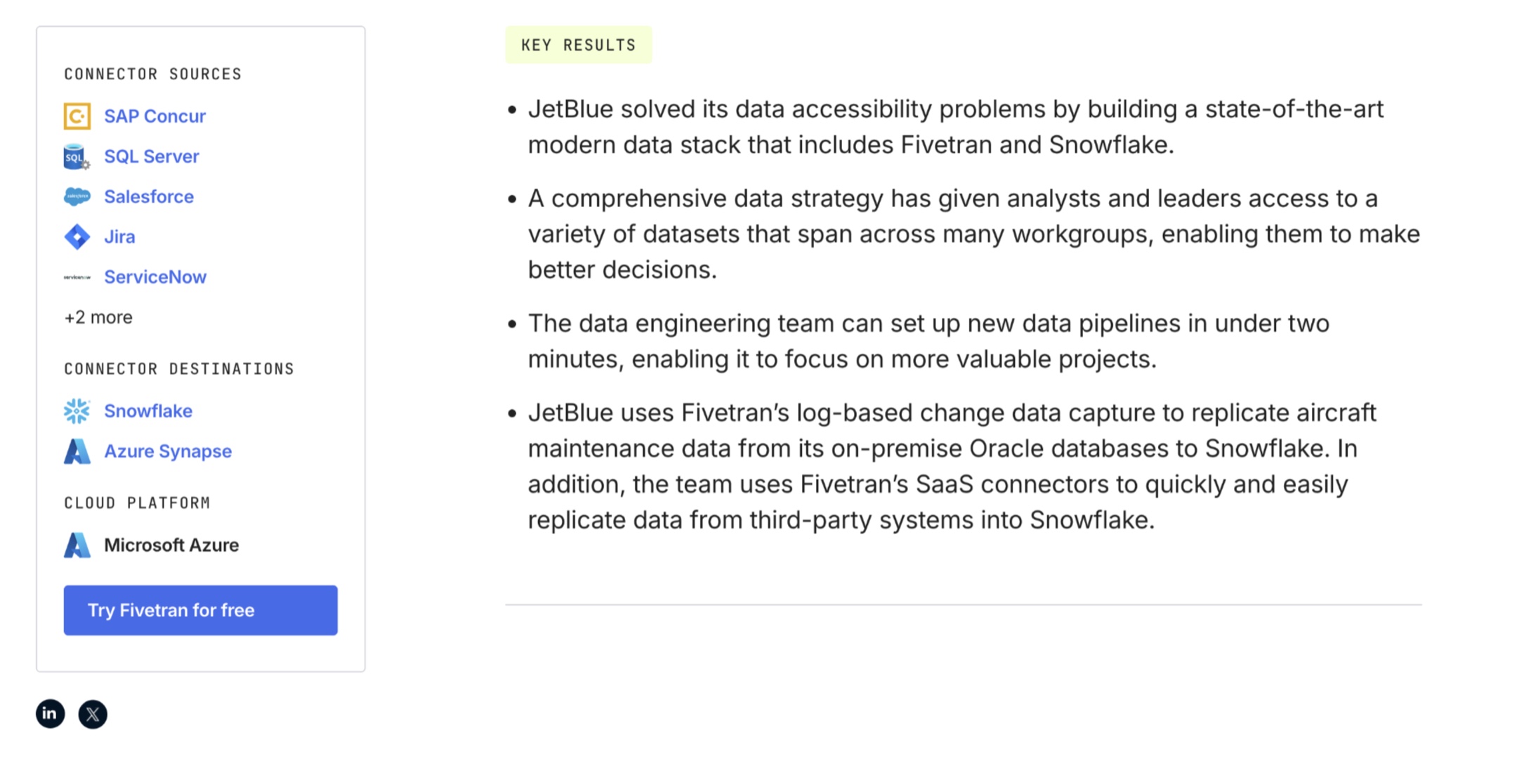
The case study page surrounding the video carried the technical detail in a right-rail sidebar: connector sources, destinations, cloud platform. Anyone who wanted to know what JetBlue actually ran found it one click away. For deeper proof, we wrote longer pieces. The Untitled Agency blog post walked through the entire data pipeline Untitled had built on Powered by Fivetran, with screenshots and architectural diagrams.
The hero kept the focus on the customer while everything around it carried the product.
How we activated the story
We wanted the JetBlue story to show up wherever a data leader might already be looking. That meant planning the distribution across owned, earned, paid, and partner channels.
Owned
The hero video sat on the Fivetran homepage for an extended run, then moved to the higher-traffic product pages: cloud platform, connector pages, the surfaces where prospective buyers were already evaluating us. And of course on JetBlue's case study page, where it's still live today. The homepage placement held attention.
Social
We cut the video into short clips for LinkedIn and seeded them through Fivetran's employee advocacy program of 500+ participants. We also ran paid placements behind the cuts to reach data engineering audiences in the segments that mattered. The same approach scaled across the Broncos, Blend, and Untitled.
Earned
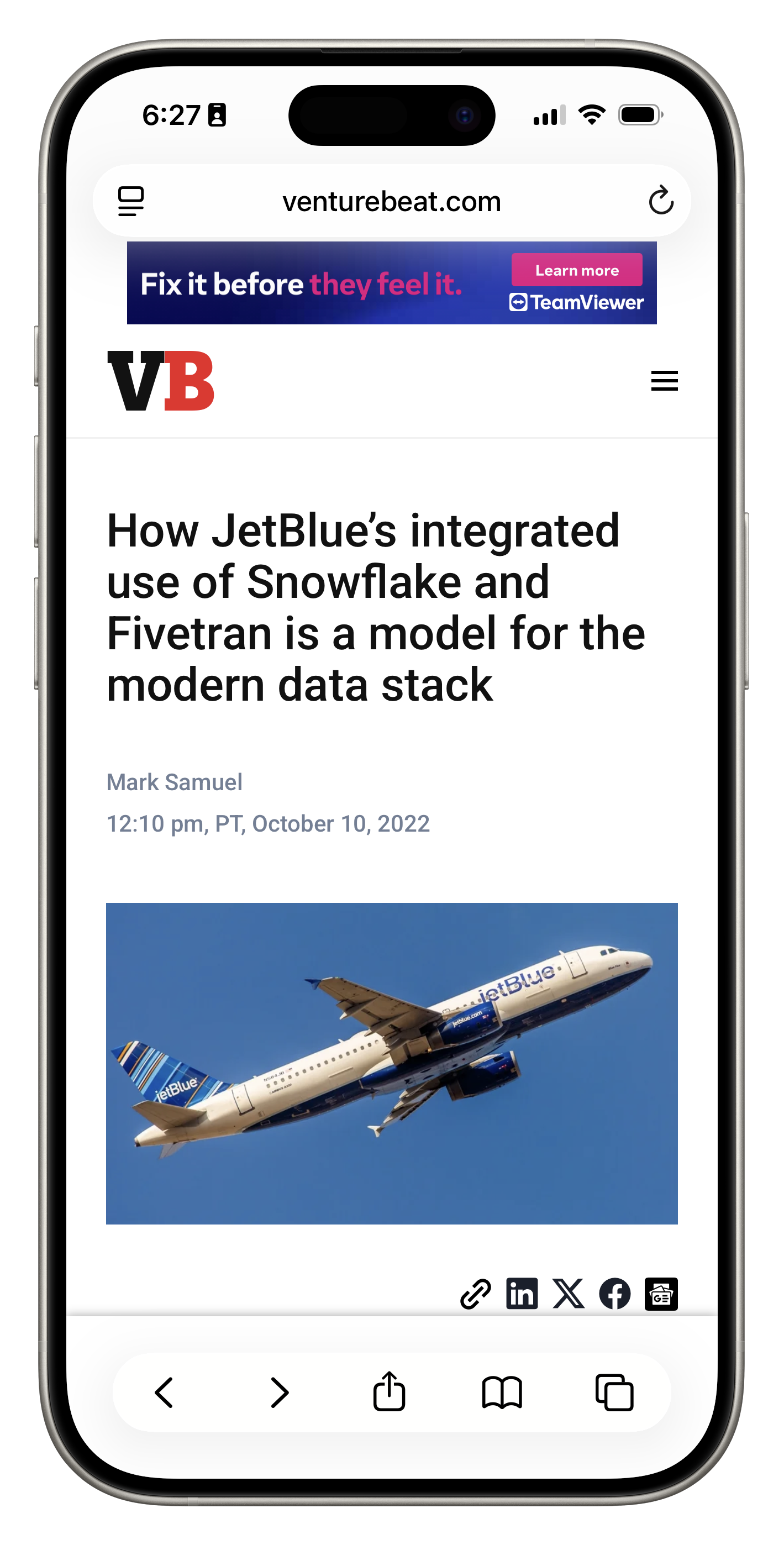
We pitched the JetBlue story to industry press, Ashley took the interview, and VentureBeat ran a feature on JetBlue's modern data stack.
The biggest earned moment of the year was Forbes. In August 2022, Forbes ran a long-form exclusive on Fivetran's co-founders. We bought the rights to the piece, built a dedicated landing page at fivetran.com/forbes, and added the JetBlue video to it as the customer proof point. The page is still live today.
Partner
Ashley spoke at Snowflake Summit 2022 in a joint Fivetran/Snowflake/JetBlue session on modern data infrastructure. We launched the hero video on YouTube the day before, June 15, 2022, to ride the announcement that Fivetran had been named Snowflake's Data Integration Partner of the Year.
How the work got done
The program was framed against a company-wide push: Fivetran was moving upmarket, and customer storytelling was the visible content response. That made the work everyone's project, not just ours.
The campaign ran out of a small cross-functional pod, led by content and brand comms (my team) with embedded partners from sales, customer success, brand and creative, product marketing, and comms. A technical PMM was in the pod from day one, making sure each customer's stack got represented accurately on case study pages and in sales enablement. Connector sources, destinations, cloud platform: all called out where engineering buyers would look.
Sales and customer success
This was the hardest and most rewarding partnership. Identifying the right customers meant sales and CS had to share their customer relationships with marketing, which is historically a fight. Sales wants to control communications with customers, usually optimized for upsell or expansion.
We turned the dynamic into a shared incentive by getting sales and CS bonused that year on customer storytelling participation. They started surfacing customers we wouldn't have found otherwise and brokering introductions faster.
Brand and creative
Brand and creative didn't report into marketing. They sat under design, which rolled up into the COO. Getting their best work on this program meant selling them on the why, not just resourcing them. We had to make the customer-as-hero principle something they wanted to make great.
Working without direct authority changed how I had to operate. The program had to win on its merits inside every conversation, and the partnership got stronger for it.
What didn't ship
Five videos got made. Four shipped. , the legacy-enterprise complement to JetBlue, the oil-and-gas proof point in the lineup.
We flew the crew to Texas. We did the shoot. We had the cut. Then our hero, who had been at Exxon for twenty years, left. Exxon's legal team put a hard stop on the video.
That was the program's structural weakness. When the campaign rests on individuals, you inherit their decisions. The customer-as-hero approach was the right call. It came with a tail risk we couldn't fully insure against, and Exxon was the one we paid.
Results and what came next
The launch metrics were strong. Millions of views, tier-1 earned media in Forbes and VentureBeat, hundreds of influenced deals across the four customers featured. JetBlue's completion rate hit 73%, well above B2B norms.
By the numbers
But the more telling signal is what happened after launch.
The JetBlue video stayed on Fivetran's homepage for roughly three years. It is still in active use today, appearing in Fivetran's LinkedIn feed and paid media. Snowflake made their own JetBlue video shortly after ours. Databricks made one too. The fivetran.com/forbes campaign landing page is also still live, with the JetBlue video anchoring it.
Views and completion rates tell you a piece is working at launch. They don't tell you whether it was built to last. Most B2B content from 2022 has aged out: product launches superseded, feature comparisons no longer relevant, positioning moved on. Customer stories about real work age differently. Ashley's job at JetBlue is recognizably the same job five years later. The work she described is still real, and the video keeps earning its placement.
Three-plus years out, Fivetran is genuinely credible in the enterprise. The customer roster today is materially stronger than it was in 2022. No marketing program moves a company upmarket on its own. Product, sales, and timing do that work. But this program supplied the customer evidence everything else in the GTM motion could lean on.
OpenAI is now a Fivetran customer. The OpenAI logo leads the customer roster and headlines the boilerplate. This brief is about a program built to bring in exactly the kind of customer Fivetran now counts among its biggest.

How I'd build this today
Three things would be different now.
- Move faster. The biggest risk we ran was the gap between customer buy-in and shipping the video. That window is where Exxon got lost. With AI in the editorial and production loop today, the timeline compresses from months to weeks, if not days. Storyboards, transcription, rough cuts, social adaptations: AI collapses the bottlenecks. The risk of a hero leaving doesn't go away, but the window shrinks dramatically.
- More video, more often. We shipped more than 20 customer stories at Fivetran but only four of those were video. Hero videos earned their full-production budget because they were the proof points the campaign was built around. The bigger lesson is the space between hero-tier and nothing. Lean crews, remote shoots, customer-captured footage cut by an editor. AI makes that middle tier viable at volume. Save the high-production budget for the stories that earn it. Fill the rest of the program with the middle tier.
- Run my own discovery. At Fivetran, we leaned on sales and CS relationships to surface customer stories. That worked, but the pipeline depended on someone else's intuition. Today the marketing team can go find stories itself: AI mining of sales calls, success calls, and product usage data surfaces the moments worth telling, in the customers' own language. At Mento I've built a version of this with semantic search across our customer call transcripts.
How I'd build this at OpenAI
The content function has been rewired over the past couple of years. AI cuts production costs, shortens ship cycles, and lets a small team go deep into source material in ways that used to take a big one.
Here's what that means for leading B2B content at OpenAI:
-
Ship to learn. Tempo is itself a learning strategy. I'd rather ship twelve experiments and keep four than perfect one and miss what the others would have taught us. Publish, kill what isn't working, learn what our audience responds to by putting it in front of them. The editorial engine runs on signals only OpenAI can see: research conversations, customer deployments, and support questions.
-
Meet the audience where they are. Invest in our owned properties so they work as destinations in their own right, places people want to explore, where one good piece pulls you toward the next.
When we show up on other channels, build for the channel. The LinkedIn audience, the YouTube audience, and the Substack audience are different people in different moods. Forcing the same content to work across all of them is how you lose trust.
-
Sell to people, not businesses. B2B is a confusing label. We don't market to companies. We market to the people inside them, who have jobs and bosses and bills and ambitions and bad days. A CEO, a developer, and a frontline employee are all asking a version of the same question: what can I do with AI, and what changes when I do? Content needs to answer that question at different levels.
People don't remember stats or spec sheets. They remember stories, and how you made them feel. That's true in every era of marketing, and especially true now. AI is making people anxious about their work and what their careers become. Content that doesn't see the human in the audience will land wrong.
-
Turn research into practice. OpenAI is a research lab. The audience for B2B content is trying to figure out what AI means for their work. The translation work is the function's biggest unfair advantage: taking what's happening at the frontier and turning it into something a marketer or an ops lead can use Monday morning. That means researchers in the work itself, executives speaking from a research-grounded position, and external experts extending the translation outward. The work shows up as explainers, customer stories, workflow playbooks, and executive narratives. Done well, this content can only come from OpenAI.
Success looks like a function that ships fast, makes our audience smarter about applying AI to their work, and gets pulled into customer conversations because it's useful.
Thank you for reading, and for the opportunity to put my thinking down. This is genuinely a dream job for me.
— Jeppe